Why Smart Textiles Matter for Modern Lifestyles
- Leroy Hughes

- Feb 27
- 10 min read

For active professionals who care about both performance and environmental impact, the promise of clothing that thinks alongside you is more than a trend. Smart textiles blend advanced sensors, conductive fibers, and sleek design to deliver fabrics that can sense, react, and adapt in real time. These intelligent fabrics do more than monitor your health or comfort—they raise the bar for durability and convenience, molding to meet the fast-paced demands of modern urban life.
Table of Contents
Key Takeaways
Point | Details |
Smart Textiles Integrate Technology | Smart textiles are embedded with sensors, fibers, and microelectronics that actively monitor and respond to body and environmental conditions. |
Types of Smart Textiles | They exist in three categories: Passive, Active, and Ultra-smart, each offering varying levels of functionality and adaptability. |
Real-World Applications | These textiles are applied in health monitoring, athletic performance, and temperature regulation, enhancing daily life and urban living. |
Focus on Durability and Sustainability | Quality smart textiles must ensure long-term durability and consider environmental impacts, promoting sustainable fashion practices. |
What Are Smart Textiles and How They Work
Smart textiles sound futuristic, but they’re already woven into everyday life. These are fabrics embedded with technology that sense, react, and communicate with you in real time.
Unlike traditional clothing, smart textiles aren’t passive. They actively monitor your body, your environment, or both. The magic happens through integrated sensors, conductive fibers, and microelectronics built directly into the fabric structure.
The Core Technologies
Conductive fibers form the nervous system of smart textiles. These specially treated yarns conduct electricity throughout the fabric, allowing data to flow continuously. They’re typically made from materials like stainless steel, silver-coated polymers, or carbon-enhanced threads.
Embedded sensors detect everything from temperature and moisture to heart rate and movement patterns. These sensors collect physiological data and environmental information without adding bulk or discomfort to your clothes.
Microcontrollers and processors receive data from sensors, process it, and trigger responses. Many smart textiles connect to your smartphone or wearable ecosystem through Bluetooth or WiFi.
Here’s what makes smart textiles actually functional:
Monitor health metrics like heart rate, body temperature, and sleep quality
Track physical activity, steps, and calories burned during workouts
Adapt to temperature changes by regulating insulation automatically
Harvest energy from body heat or movement to power devices
Provide real-time feedback to improve athletic performance
Alert you to potential health concerns through connected apps
How They Actually Work in Practice
Electronic textiles enable functionalities that go far beyond what regular fabric can do. When you wear a smart shirt, sensors continuously gather data from your skin. That data flows through conductive fibers to a processor, which interprets patterns and sends insights to your phone.
Think of it like giving your clothes a brain and nervous system. The sensors are nerve endings, the conductive fibers are neural pathways, and the processor is the decision-making center.
For active professionals, this means real-time performance tracking without carrying extra devices. Your shirt becomes your coach, your health monitor, and your data collector rolled into one.

Real-World Applications
Smart textiles aren’t just lab concepts. They’re solving actual problems:
Posture correction during desk work by detecting slouching
Athlete performance optimization through movement analysis
Recovery monitoring after injury or surgery
Stress level detection through heart rate variability
Sleep quality improvement through nighttime temperature regulation
The best part? Modern smart textiles maintain the comfort and durability you expect from quality clothing while adding technological benefits.
Pro tip: When choosing smart textiles for your lifestyle, prioritize pieces that remain functional even if the technology fails—look for fabrics with superior durability and performance benefits built into the material itself, not just the electronics.
Types of Smart Textiles and Key Features
Not all smart textiles work the same way. The category you choose depends on what you need your clothing to do—simply sense, react, or intelligently adapt.
Think of smart textiles as existing on a spectrum from basic to advanced. Each tier adds more capability and complexity to how your garment interacts with your body and environment.
The Three Main Categories
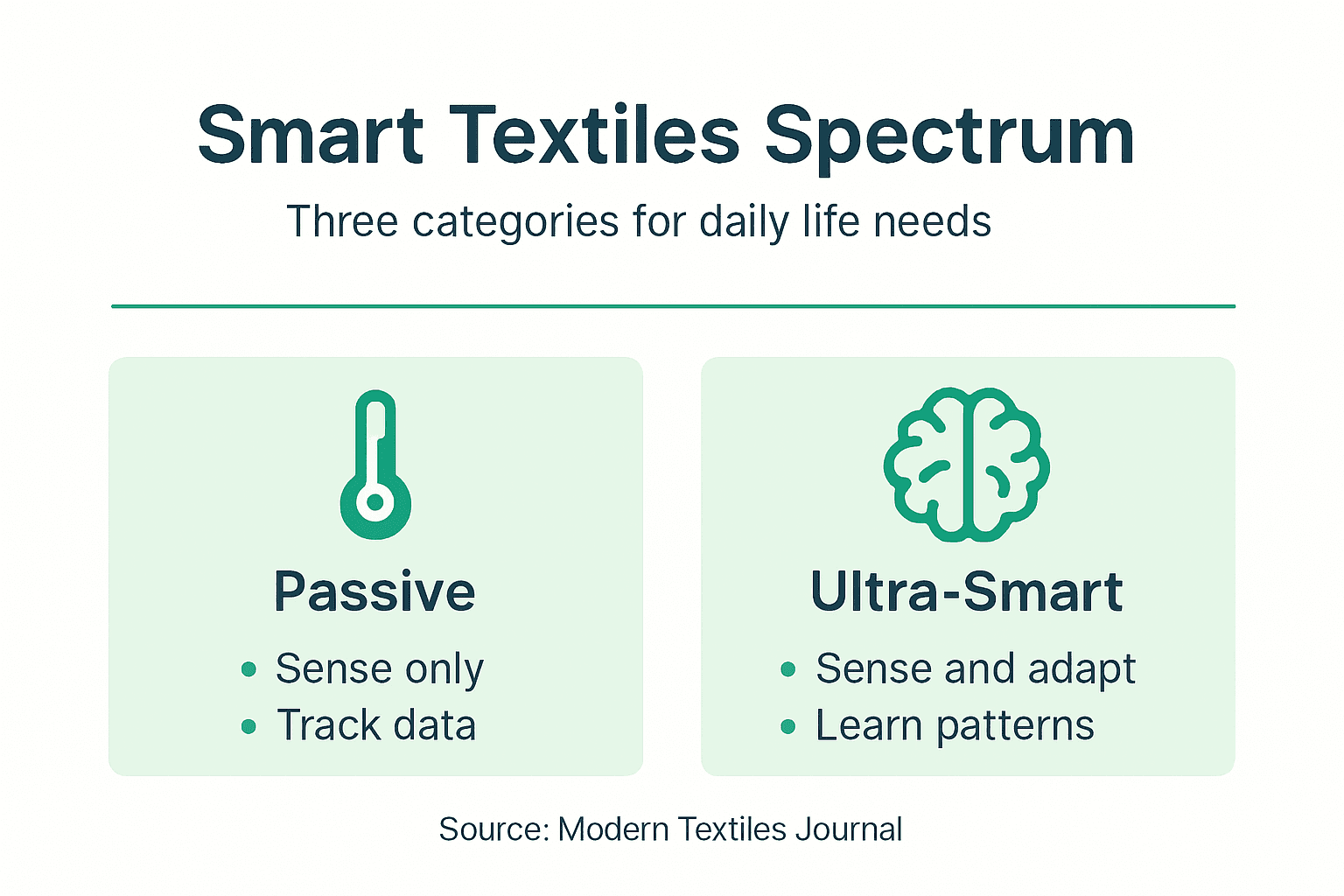
Passive smart textiles only sense and collect data. They detect environmental changes like temperature, humidity, or movement but don’t respond automatically. Your outfit becomes a data gatherer, feeding information to your connected devices for analysis.
Active smart textiles sense and respond. They detect stimuli and trigger immediate reactions without requiring external input. Temperature rises? The fabric adjusts its thermal properties. Your heart rate spikes? The material increases breathability.
Ultra-smart textiles represent the cutting edge. These fabrics sense, respond, and adapt intelligently based on patterns and conditions. They learn your preferences over time and make autonomous adjustments for optimal comfort and performance.
Here’s a quick comparison of the three main categories of smart textiles:
Category | Core Function | Level of Adaptability | Typical Use Cases |
Passive | Data collection only | No response or adaptation | Fitness tracking, health monitoring |
Active | Senses, then responds | Automatic adjustments | Athletic wear, thermal regulation |
Ultra-smart | Learns, adapts autonomously | High, personalized changes | Professional wear, complex environments |
Key Features That Matter
Smart textiles include sensors and data processing units woven directly into the fabric structure. Here’s what makes them function:
Conductive fibers enable data flow throughout the garment
Embedded sensors monitor body metrics and environmental conditions
Actuators physically respond to detected changes
Microcontrollers process information and make decisions
Communication systems connect your clothes to smartphones and wearables
Energy systems power the technology through harvesting or batteries
What Actually Works in Daily Life
For busy professionals, the most practical features are those that enhance comfort without maintenance hassles. Real-world performance matters more than technical complexity.
Durability is non-negotiable. Your smart shirt must survive washing, stretching, and regular wear without losing functionality. The best smart textiles integrate technology seamlessly into fabric that already performs exceptionally.
Comfort comes first. If the technology makes the garment uncomfortable or restricts movement, you won’t wear it consistently. Quality smart textiles feel like regular clothes while delivering technological benefits.
The most successful smart textiles balance advanced technology with everyday wearability—they enhance your life without requiring you to change how you dress.
Real Applications by Category
Passive smart textiles work best for fitness tracking and health monitoring where you want detailed data without automatic adjustments. Active smart textiles excel in athletic wear that responds to body temperature in real time. Ultra-smart textiles suit professionals who need continuous adaptation throughout demanding days.
Pro tip: Start with passive smart textiles to understand how wearable technology integrates into your lifestyle, then upgrade to active options once you’ve confirmed the benefits match your needs.
Everyday Applications Shaping Urban Living
Smart textiles aren’t confined to athletic wear anymore. They’re quietly transforming how you live, work, and recover in your urban environment—from the clothes on your body to the spaces you occupy.
For tech-savvy professionals balancing demanding careers with active lifestyles, smart textiles solve real problems. They eliminate friction from your daily routine while delivering measurable health and wellness benefits.
Health Monitoring That Stays With You
Imagine your shirt tracking your vital signs throughout the workday without any additional devices. Smart textiles embedded with biometric sensors collect heart rate, respiratory patterns, and stress indicators continuously.
This data flows directly to your smartphone, creating a comprehensive health picture. You don’t need a dedicated fitness tracker when your clothes already monitor everything.
The practical advantage? You get actionable insights about your cardiovascular health, sleep quality, and stress levels without changing your routine.
Temperature Regulation Without Layers
Adaptive thermal textiles adjust to your body temperature in real time. Cool when you overheat, insulating when you chill—all automatically.
For urban professionals, this means ditching bulky outerwear. A single smart jacket replaces multiple seasonal pieces, simplifying your wardrobe while maintaining comfort across temperature fluctuations.
This technology uses phase-change materials or piezoelectric fibers embedded in fabric. No batteries required. Just intelligent fabric responding to your body’s needs.
Smart Interiors and Home Comfort
Smart textiles enhance comfort in interior spaces through environmental monitoring and energy management. Smart curtains track indoor humidity and adjust to optimize climate control. Sensor-embedded upholstery monitors air quality in real time.
Beyond comfort, these textiles support sustainability. Piezoelectric fibers harvest energy from movement and temperature differences, reducing reliance on traditional power sources.
Active Recovery and Performance Optimization
Wearable smart textiles provide real-time feedback during workouts and recovery periods:
Track movement patterns to correct posture and prevent injury
Monitor muscle fatigue levels before overtraining
Detect recovery readiness through heart rate variability analysis
Measure sweat patterns to optimize hydration strategies
Alert you when muscle tension indicates overuse
Where Urban Professionals Benefit Most
Office workers get posture monitoring during long desk sessions. Athletes receive performance analytics without carrying devices. Travelers maintain health tracking across time zones automatically.
The common thread? Smart textiles integrate seamlessly into existing lifestyles without demanding attention or maintenance.
Smart textiles work best when you don’t think about them—they enhance your life through invisible functionality built directly into fabric you already wear.
The Sustainability Angle
Quality smart textiles last longer than traditional fast fashion. One durable, multi-functional piece replaces several single-purpose garments, reducing overall wardrobe volume and environmental impact.
When technology fails, the underlying fabric still performs exceptionally. You’re not forced to discard the entire garment.
Pro tip: Invest in smart textiles that deliver performance benefits through both fabric technology and embedded electronics—this ensures your clothing remains functional and valuable even as technology advances.
Sustainability, Cost, and Performance Factors
Smart textiles promise incredible benefits, but the real-world equation involves three competing priorities: environmental responsibility, affordability, and durability. Understanding these tradeoffs helps you make smarter purchasing decisions.
Right now, smart textiles exist at a premium price point. That’s changing as manufacturing scales, but sustainability considerations add complexity to the cost equation.
The Sustainability Challenge
Sustainable smart textiles emphasize biodegradability and recyclability while reducing overall environmental impact. The goal is clear: create high-performance garments that don’t harm the planet.
The reality is messier. Embedding sensors and conductive fibers requires specialized manufacturing processes that currently consume significant energy. Electronic components create disposal challenges if not designed thoughtfully.
But innovation is accelerating. Manufacturers are developing eco-friendly conductive fibers from organic materials and creating modular designs where technology separates from fabric for recycling.
Cost Factors Breaking Down
Smart textiles cost more than regular clothing for specific reasons:
Energy-intensive manufacturing processes for conductive fibers
Research and development for new materials and integration methods
Sensor technology and microelectronics embedded in each garment
Quality assurance testing to ensure durability and performance
Smaller production volumes compared to mass-market apparel
Specialized expertise required for production and assembly
Performance Durability Matters Most
A $200 smart shirt means nothing if it fails after five wears. Real value comes from garments that maintain functionality for years while the underlying fabric never degrades.
The best smart textiles separate the technology equation from the fabric equation. If the electronics fail, the shirt still performs as exceptional apparel through advanced fabric technology.
This is why durability matters more than cutting-edge sensors. A durable garment that lasts three years justifies higher upfront cost.
The Circular Economy Approach
Design-for-disassembly is reshaping how smart textiles are manufactured. Sensors and electronics attach modularly, allowing you to remove technology for recycling while keeping the fabric garment.
This approach extends lifespan, reduces waste, and lets you upgrade technology without replacing the entire piece.
Review key factors influencing sustainability, cost, and value in smart textiles:
Factor | Impact on Value | Potential for Improvement | Consumer Consideration |
Manufacturing Energy | Raises cost, environmental footprint | Lower energy processes are emerging | Choose eco-friendly options |
Technology Integration | Increases durability, complexity | Modular designs enable longevity | Look for separable electronics |
Base Fabric Quality | Ensures garment use if tech fails | Advanced, recyclable materials | Prioritize lasting comfort |
Recycling Options | Reduces waste, promotes reuse | More modular assembly anticipated | Consider ease of disassembly |
Smart textiles deliver genuine value only when durability matches innovation—cutting-edge sensors mean nothing if the garment falls apart after a season.
Making the Economic Case
Consider total cost of ownership, not just purchase price. One smart garment replacing three regular pieces, lasting three times longer, and delivering health benefits throughout justifies premium pricing.
For active professionals, the time savings from integrated health monitoring and performance optimization adds measurable value beyond fabric quality.
Environmental Impact Timeline
As manufacturing scales and processes improve, environmental footprint decreases. Production in five years will likely be significantly more sustainable than today’s methods.
Investing now supports companies developing better processes for the future. Your purchase drives demand for sustainable innovation.
Pro tip: Choose smart textiles where both the base fabric and embedded technology deliver value independently—prioritize pieces with proven durability records and modular design, so you’re protected even if technology becomes obsolete.
Elevate Your Everyday Style with Functional Smart Textiles
The article highlights the challenge of integrating technology into clothing without losing comfort, durability, and style. If you are an active professional seeking easy-care, high-performance apparel that supports health monitoring and adapts to your busy lifestyle, then embracing advanced fabric technology is a must. Concepts like conductive fibers, embedded sensors, and adaptive thermal regulation bring smart textiles into focus, but real value comes from garments that combine innovation with lasting wearability.
At LABFRESH | Shirts, we deliver exactly this balance. Our unique FreshCore™ and Seawool fabric technologies offer odor-resistance, stain-resistance, and low-maintenance benefits that make your clothing work as hard as you do. Designed for seamless integration with your lifestyle, our pieces emphasize comfort, durability, and sustainability, so you can experience the benefits of smart textiles without sacrificing style or ease.
Discover the difference today.
Shop now at LABFRESH to upgrade your wardrobe with technically advanced apparel. Experience high-tech fabrics that keep up with your performance goals while simplifying your daily routine. Explore our full collection and find smart textiles that match your modern lifestyle today.
Frequently Asked Questions
What are smart textiles?
Smart textiles are fabrics embedded with technology that can sense, react, and communicate in real-time, monitoring aspects like body metrics and environmental changes.
How do smart textiles work in practice?
Smart textiles use integrated sensors to gather data from your skin, which is processed by microcontrollers to provide insights on health metrics, performance, and other responses without additional devices.
What types of smart textiles are available?
Smart textiles are categorized into three types: passive, which only collect data; active, which respond to stimuli; and ultra-smart, which learn and adapt autonomously for optimal comfort and performance.
How can smart textiles enhance everyday life?
Smart textiles improve daily life by providing health monitoring, temperature regulation, posture correction, and performance optimization, all while maintaining comfort and durability in clothing.
Recommended
Comments