What is ethical clothing? Principles, certifications, and impact


TL;DR:
Ethical clothing involves fair labor, responsible sourcing, and circular design with transparency.
Certifications like GOTS and Fair Trade verify specific ethical and environmental standards, but no single standard covers everything.
True sustainability requires combining environmental impact reduction with fair labor practices, not just surface-level claims.
The fashion industry accounts for 10% of global carbon emissions and produces 92 million tonnes of textile waste every year, yet “ethical” and “sustainable” labels are plastered on everything from fast-fashion tees to luxury outerwear. Most of those claims don’t hold up under scrutiny. We built this guide to cut through the noise, giving you a clear framework for what ethical clothing actually means, how certifications work, where ethics and sustainability overlap (and where they don’t), and what the latest textile technology is doing to push the whole industry forward. If you care about where your clothes come from and who made them, this is the starting point.
Table of Contents
Key Takeaways
Point | Details |
Ethical means people-first | Ethical clothing puts fair labor, safe conditions, and full supply chain transparency at its core. |
Certifications verify claims | Look for trusted certifications like GOTS, Fair Trade, and OEKO-TEX to confirm brands’ ethical standards. |
Ethical and sustainable differ | The best clothing choices support both workers and the planet, but each word means something distinct. |
Beware of greenwashing | Watch out for vague eco-labels and demand clear evidence to avoid marketing traps. |
Innovation is the future | Tech-integrated, eco-conscious fashion offers new ways to balance style, function, and ethics. |
Core principles of ethical clothing
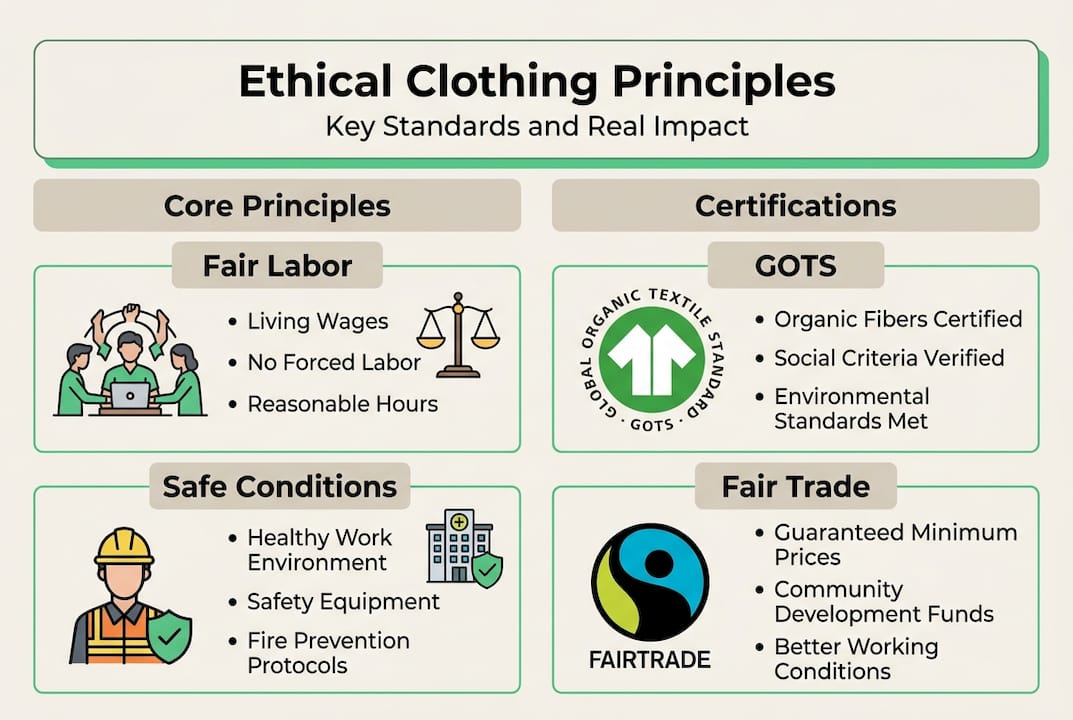
Ethical clothing is not a vibe or a marketing angle. It is a set of concrete commitments that run through every stage of a garment’s life, from raw fiber to finished product to end-of-life disposal. At its core, fair wages, no forced labor, artisan support, and low-impact materials define what separates a genuinely ethical brand from one that just talks a good game.
The principles break down into three interconnected areas:
Fair labor: Workers receive living wages, work in safe conditions, and are free from coercion or discrimination at every point in the supply chain.
Responsible sourcing: Raw materials are chosen for low environmental impact, and material sourcing transparency is documented and publicly accessible.
Circular design: Garments are built to last, designed for repair or recycling, and kept out of landfill as long as possible.
Transparency is the thread that ties all three together. Full lifecycle transparency and third-party certifications are how brands prove these commitments rather than just stating them. Without that verification layer, “ethical” is just a word.
“Ethical fashion is not a trend. It is a standard of accountability that covers every hand that touches a garment.”
What does NOT count as ethical practice? Offsetting poor labor conditions with a recycled-polyester fabric. Donating 1% of profits to a charity while paying factory workers below minimum wage. Releasing a small “conscious collection” while the rest of the catalog is business as usual. These are the kinds of partial measures that let brands claim ethical status without earning it.
Pro Tip: When a brand uses phrases like “responsibly made” or “eco-conscious” without linking to supplier audits or certification documents, treat it as a red flag. Genuine ethical brands show their work.
Certifications and how to verify ethical claims
With a clear framework in mind, the next step is understanding how these principles become verifiable. Certifications are the most reliable tool you have, but they are not all equal in scope or rigor.
Key certifications that carry real weight include GOTS (Global Organic Textile Standard), Fair Trade, OEKO-TEX, and Textile Exchange standards. Here is what each one actually covers:
Certification | Primary focus | Covers labor? | Covers environment? |
GOTS | Organic fiber processing | Yes (partially) | Yes (strongly) |
Fair Trade | Supply chain equity | Yes (strongly) | Partially |
OEKO-TEX STANDARD 100 | Chemical safety in textiles | No | Partially |
Textile Exchange | Responsible fiber sourcing | No | Yes |
No single certification covers everything. That is the critical insight most shoppers miss. A shirt with an OEKO-TEX label is free from harmful chemicals, but that tells you nothing about whether the factory workers were paid fairly. A textile certifications overview helps you see how these standards layer together rather than replace each other.
Here is a practical process for vetting a brand’s ethical claims:
Search the brand’s website for a dedicated supplier or transparency page.
Identify which certifications they hold and cross-reference on the certifier’s official database.
Check whether the certification covers the full supply chain or just one stage (e.g., fiber only).
Look for certification examples in practice such as published audit results or factory lists.
Verify that Fair Trade standards apply to the specific product you are buying, not just a subset of the brand’s range.
Limited certification coverage is one of the most common gaps. A brand might certify its organic cotton sourcing but leave its dyeing and finishing processes unaudited. That gap is where labor abuses and chemical pollution tend to hide.
Ethical vs. sustainable: Why the distinction matters
Once you know how to check for ethics, it is important to understand how ethics diverges from sustainability, because conflating the two leads to incomplete decisions.

Ethical focuses on people and labor; sustainable focuses on the planet and emissions. Both matter, and the best brands pursue both simultaneously, but they are not the same thing.
Dimension | Ethical clothing | Sustainable clothing |
Primary concern | Human rights, fair pay, safe conditions | Environmental impact, resource use, pollution |
Key metrics | Living wage compliance, audit results | Carbon footprint, water usage, waste output |
Overlap zone | Responsible sourcing, supply chain transparency | Responsible sourcing, supply chain transparency |
Here is why both are necessary:
A brand can use 100% organic cotton while still underpaying its workers. That is sustainable but not ethical.
A brand can pay living wages while using virgin polyester and toxic dyes. That is ethical but not sustainable.
Only when both dimensions are addressed does a brand genuinely earn the trust of conscious shoppers.
The environmental stakes are significant. Fashion’s share of global CO2 emissions sits at 10%, making it one of the most polluting industries on the planet. That is why circular design in practice matters so much. Designing for longevity reduces both waste and the repeated environmental cost of producing replacement garments.
At LABFRESH, we treat ethics and sustainability as parallel tracks, not interchangeable ones. Our brand’s sustainability initiatives reflect that dual commitment, from material choices to production partners.
Cutting through greenwashing and edge cases
Understanding definitions sets the stage for recognizing the real-world pitfalls that even well-intentioned shoppers encounter. Greenwashing is widespread, and it is getting more sophisticated.
Warning signs to watch for:
Vague language: “Eco-friendly,” “green,” and “conscious” without supporting data.
Tiny eco collections: A brand releases 5 “sustainable” styles while the other 500 remain unchanged.
Aspirational storytelling: Brands use forward-looking language about goals they have not yet reached as if those goals are current reality.
Selective certification: Certifying one input (like the cotton) while leaving everything else unverified.
Certifications like Fair Trade cover only 18 to 37% of a brand’s output in many cases, which means a brand can display a Fair Trade logo while the majority of its production operates under unverified conditions. That is not a loophole; it is a systemic gap that requires consumer pressure to close.
Secondhand clothing is another area where the picture is more complicated than it seems. Buying used garments can reduce waste, but secondhand’s hidden pitfalls show that secondhand buying often correlates with continued fast fashion consumption. The logic: buying cheap secondhand items can free up budget and psychological permission to also buy new fast fashion. The net result is sometimes more consumption, not less.
Pro Tip: Ask brands for evidence, not just logos. Request links to audit reports, supplier databases, or third-party verification. A brand that cannot provide these documents is a brand that has not done the work.
What’s next: Smart textiles and the future of ethical clothing
With greenwashing pitfalls in mind, the most exciting development in ethical clothing is the convergence of sustainability and high-performance textile technology. This is where innovation is genuinely moving the needle.
Smart textiles integrating MoS2, system-on-fiber integrated circuits, and eco-friendly nanomaterials are combining sustainability with entirely new functionality. These are not concept-stage ideas. In 2026, wearable electronics woven directly into washable fabrics are entering practical application.
Here is what that looks like in practice:
MoS2-enhanced fabrics: Molybdenum disulfide (MoS2) is a naturally occurring mineral used to create ultra-thin, flexible layers in fabric that can conduct electricity or sense pressure, all while remaining washable and lightweight.
System-on-fiber ICs: Integrated circuits embedded directly into yarn allow garments to monitor health metrics or environmental data without added bulk or battery packs.
Eco-friendly nanomaterials: New finishing processes use nano-scale treatments to achieve odor resistance, stain resistance, and durability without the toxic chemicals traditionally required.
Why does this matter for ethical clothing? Because performance and ethics are no longer in tension. A garment built to last five years with smart functionality reduces the consumption cycle that drives both labor exploitation and environmental damage. Longer-lasting clothes mean fewer replacements, less factory output, and less waste.
The brands worth watching are those combining verified ethical sourcing with genuine material innovation, not just one or the other.
The uncomfortable truth: There’s no perfect ethical brand yet
We want to be direct with you: no clothing brand is 100% ethical. Not us, not the most celebrated sustainable labels, not anyone operating at scale in today’s global supply chain. No brand is 100% ethical; the reality is a spectrum from basic compliance to genuine transparency, and the industry moves forward through sustained consumer demand and honest accountability.
This is not a reason for cynicism. It is a reason to make smarter, more targeted choices. The most powerful actions available to you are not complicated: buy less, choose better, and keep asking tough questions. Every brand that loses a sale because it cannot answer a transparency question learns something. Every brand that gains loyalty by publishing its supplier list learns something different.
We believe the path to better clothing runs through honesty about where we all fall short, combined with real investment in doing better. Our own lessons from striving for sustainability have taught us that progress is iterative and imperfect, and that is okay as long as the direction is right.
Explore ethical and functional clothing options
Knowing what to look for is the first step. Seeing it applied is the next one.
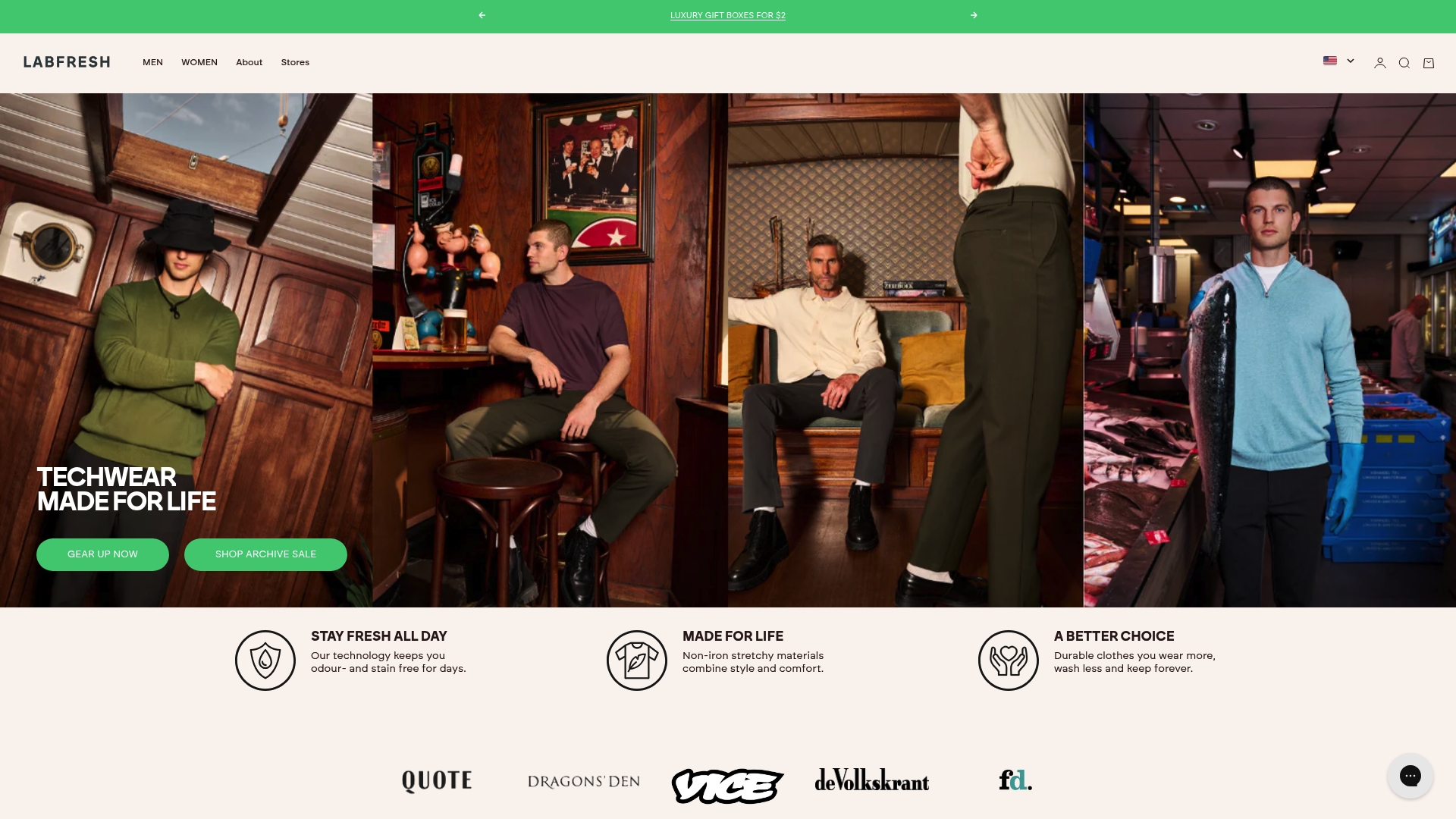
At LABFRESH, we build clothing that takes material innovation and responsible sourcing seriously. Our sustainable shirts use FreshCore™ and Seawool technologies to extend garment life and reduce the need for frequent washing, which directly lowers water and energy use. Our performance pants are designed for durability without sacrificing style. Explore the full LABFRESH collection to see how we are working toward greater transparency and tech-driven sustainability. We are not perfect, but we are committed to showing our work.
Frequently asked questions
How can I tell if a clothing brand is truly ethical?
Look for transparent supply chains and third-party certifications like GOTS or Fair Trade, along with published evidence of fair labor practices and low-impact material sourcing. If a brand cannot point you to audit results or a supplier list, that absence speaks volumes.
What is the difference between ethical and sustainable clothing?
Ethical is people-focused, centering on fair treatment of workers, while sustainable clothing focuses on reducing environmental harm. The strongest brands pursue both goals at the same time.
Are secondhand clothes always an ethical choice?
Secondhand clothes can reduce waste, but secondhand shopping can correlate with continued fast fashion consumption, which can offset the benefits. Your overall buying habits matter more than any single purchase.
What are some examples of new technology in ethical clothing?
Smart textiles combine sustainability and functionality through innovations like washable MoS2 fabrics and integrated system-on-fiber electronics, making high-performance and eco-responsible design compatible.
Can I trust ‘eco’ labels on mainstream brands?
Approach them with healthy skepticism. Greenwashing is prevalent through vague claims and limited eco collections, so always demand data-backed transparency and real third-party certifications before trusting an “eco” label.
Recommended
Comments