Why Low-Maintenance Clothing Benefits Busy Lives
- Leroy Hughes

- Feb 19
- 6 min read

Finding clothing that looks sharp, lasts, and doesn’t demand constant attention can feel impossible for busy European professionals. Real life means unpredictable meetings, travel, and social events where comfort and style should never be compromised. With new fabric technologies leading to low-maintenance clothing, you gain reliable garments that resist wrinkles, stains, and over-washing while supporting sustainability and innovative design. Discover how smarter wardrobe choices deliver convenience and lasting performance for your everyday routine.
Table of Contents
Key Takeaways
Point | Details |
Understanding Low-Maintenance Clothing | It encompasses durability, minimal care, and sustainable design, moving beyond just fabric to include lifecycle extension. |
Innovative Fabric Technologies | Technologies such as antimicrobial coatings and wrinkle-resistant finishes enhance garment longevity and reduce maintenance. |
Categories of Low-Maintenance Apparel | Includes performance sportswear, technical business attire, and travel-friendly options designed for convenience and reduced care needs. |
Environmental Impact Comparison | Low-maintenance clothing significantly reduces water and energy consumption, offering a more sustainable alternative to traditional fashion. |
Defining Low-Maintenance Clothing and Misconceptions
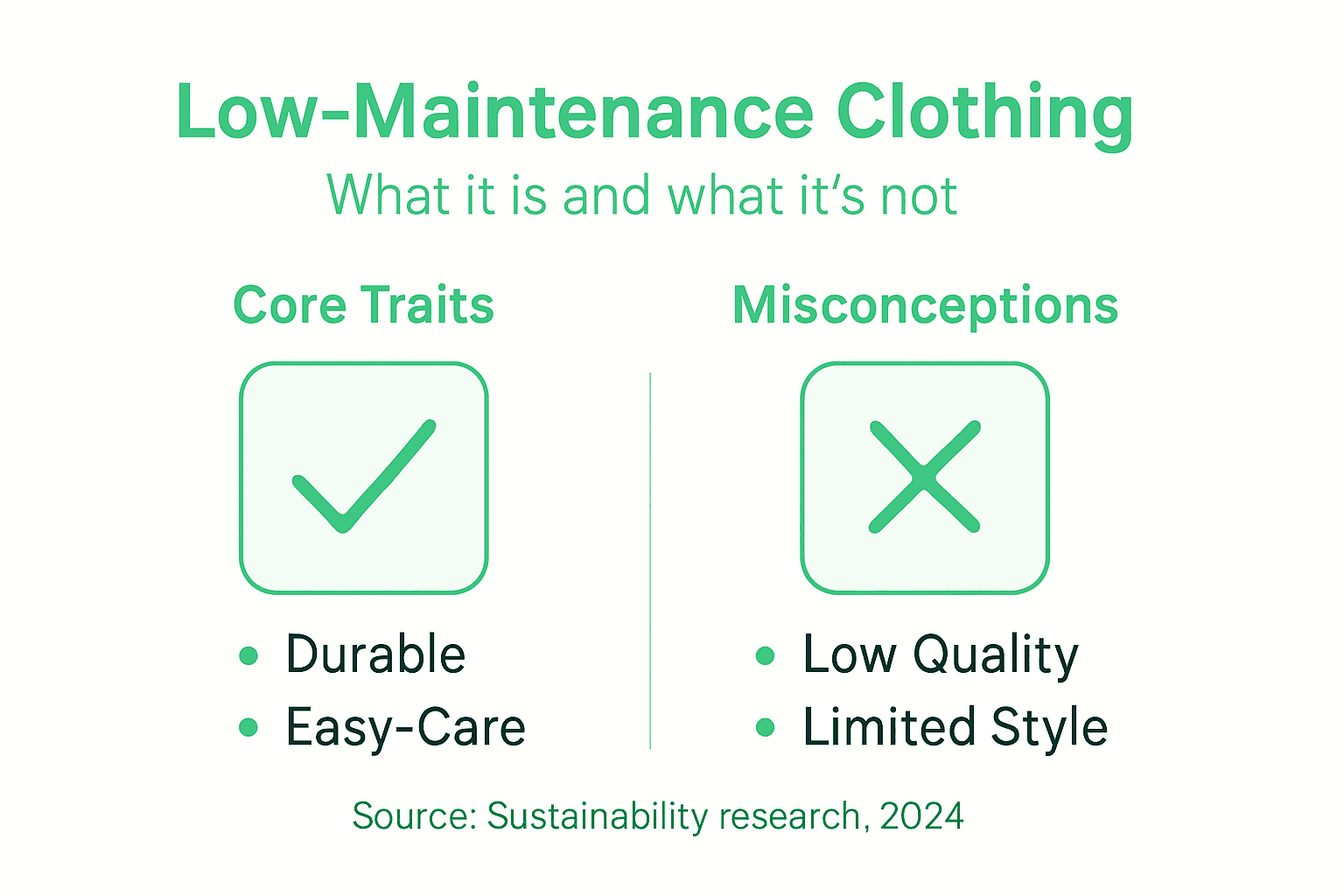
Low-maintenance clothing represents a strategic approach to personal wardrobe management that goes far beyond simple fabric selection. Global research reveals that true low-maintenance apparel involves a comprehensive understanding of garment durability, care practices, and lifecycle extension.
Traditionally, consumers mistakenly equate low-maintenance clothing with disposable fashion or exclusively technical fabrics. However, a more nuanced perspective emerges from contemporary studies. Low-maintenance clothing actually encompasses several critical dimensions:
Minimal care requirements during washing and storage
Resistance to wrinkles and fabric deformation
Ability to maintain appearance after repeated wear
Sustainable design promoting longer usage cycles
Quick-drying and stain-resistant properties
Systematic sustainability research suggests that low-maintenance clothing transcends mere technical performance. It represents an environmentally conscious approach to consumption, challenging conventional fashion industry narratives about clothing lifespan and care.
Misconceptions about low-maintenance clothing often stem from oversimplified marketing narratives. Consumers frequently assume that higher maintenance equals higher quality, when in reality, intelligent design and fabric technology can create garments that require minimal intervention while maintaining superior aesthetic and functional standards.
Pro tip: Evaluate clothing not just by its initial appearance, but by its potential for repeated, effortless wear and minimal care requirements.
Key Fabric Technologies and Material Innovations
Fabric technologies represent the cutting edge of modern clothing design, transforming how we approach personal apparel. Recent textile advancements demonstrate remarkable innovations that dramatically reduce clothing maintenance while enhancing performance and sustainability.
Innovative fabric technologies now focus on creating intelligent materials that actively respond to wearers’ needs. These technologies include:
Antimicrobial coatings that prevent odor and bacterial growth
Wrinkle-resistant finishes that maintain garment appearance
Water-repellent treatments that protect against stains and moisture
Adaptive thermal regulation fabrics that adjust to body temperature
Bio-based fibers that reduce environmental impact
Sustainable clothing research highlights how these technological interventions not only improve garment functionality but also significantly extend clothing lifecycle. Modern fabric innovations are about creating intelligent textiles that work smarter, not harder.
By integrating advanced material sciences, manufacturers can now develop clothing that requires minimal care while maintaining superior performance. These technologies represent a significant leap beyond traditional fabric manufacturing, offering urban professionals practical solutions that align with their fast-paced lifestyles and sustainability goals.
Pro tip: When shopping for low-maintenance clothing, look beyond aesthetic qualities and investigate the specific fabric technologies integrated into the garment.
The table below highlights leading fabric technologies and their benefits:
Technology | Key Benefit | Typical Use Case |
Antimicrobial Coating | Prevents odors and bacteria | Performance sportswear, travel gear |
Wrinkle-Resistant Finish | Maintains sleek appearance | Business attire, everyday shirts |
Water-Repellent Treatment | Guards against stains and moisture | Outdoor clothing, workwear |
Adaptive Thermal Fabric | Adjusts to temperature changes | Layering pieces, urban wear |
Bio-Based Fiber | Lowers environmental impact | Sustainable basics, eco collections |
Categories of Low-Maintenance Apparel Explained
Low-maintenance apparel represents a strategic approach to clothing design that minimizes care requirements while maximizing functionality. Fashion sustainability research reveals a diverse range of clothing categories engineered to meet the demands of modern lifestyles.
The contemporary low-maintenance clothing landscape can be categorized into several distinct types:
Performance Sportswear: Engineered for quick-drying and minimal washing
Technical Business Attire: Wrinkle-resistant shirts and pants for professional settings
Travel-Friendly Clothing: Versatile pieces that maintain shape and appearance
Adaptive Workwear: Garments with integrated stain and odor-resistant technologies
Sustainable Basics: Minimalist clothing designed for repeated wear and easy care
Consumer behavior studies demonstrate that these categories not only reduce maintenance time but also support sustainable consumption by extending garment lifecycle. The key is intelligent design that anticipates user needs and environmental challenges.
Understanding these categories helps urban professionals make informed clothing choices. Each category addresses specific lifestyle requirements, from minimizing ironing time to reducing overall clothing care complexity. The evolution of low-maintenance apparel represents a sophisticated intersection of material science, user experience design, and sustainability principles.
Pro tip: Prioritize multi-functional garments that combine low-maintenance features across multiple clothing categories for maximum wardrobe efficiency.
Convenience, Durability, and Everyday Functionality
Everyday functionality is more than a clothing feature—it’s a lifestyle strategy that transforms how urban professionals approach their wardrobe. Cultural clothing research reveals that true durability extends far beyond simple fabric strength.
The core attributes of convenience-driven clothing include:
Resistance to wrinkles and rapid shape recovery
Ability to withstand multiple wears between washings
Quick-drying properties that support active lifestyles
Stain-resistant treatments for unexpected spills
Thermal regulation across different environments
Minimal ironing or maintenance requirements
Qualitative studies on clothing usage demonstrate that consumers prioritize garments offering reliable performance without compromising personal style. Convenience isn’t about sacrificing aesthetic appeal, but about intelligent design that anticipates real-world challenges.

Understanding these functional requirements helps professionals curate wardrobes that work as hard as they do. Modern clothing technology bridges the gap between performance and style, creating versatile pieces that seamlessly transition from professional settings to casual environments while maintaining impeccable appearance with minimal effort.
Pro tip: Invest in multi-purpose garments that offer technical performance features while maintaining a polished, professional aesthetic.
Environmental and Sustainability Impact Compared to Traditional Fashion
Sustainable fashion represents a critical paradigm shift in how we approach clothing consumption and environmental responsibility. Comprehensive sustainability research reveals that low-maintenance clothing significantly outperforms traditional fashion in reducing ecological footprints.
Key environmental advantages of low-maintenance apparel include:
Reduced water consumption during washing
Lower energy expenditure in cleaning and maintenance
Extended garment lifecycle reducing textile waste
Minimized chemical usage in fabric care
Lower carbon emissions from repeated laundering
Decreased microplastic release during washing
Circular economy research demonstrates how these garments align with sustainable consumption principles. By designing clothing that requires less frequent washing, uses more durable materials, and maintains performance over extended periods, manufacturers can dramatically reduce environmental impact.
Traditional fashion’s linear model of production—characterized by rapid consumption and disposal—stands in stark contrast to low-maintenance clothing’s circular approach. Urban professionals can directly contribute to environmental sustainability by selecting garments engineered for longevity, minimal care, and reduced resource consumption.
Here’s a summary comparing low-maintenance clothing features to traditional fashion:
Aspect | Low-Maintenance Apparel | Traditional Fashion |
Laundry Frequency | Less frequent washing needed | Regular washing required |
Lifecycle | Extended garment lifespan | Short usage before disposal |
Resource Efficiency | Lower water and energy use | Higher resource consumption |
Maintenance Interaction | Minimal ironing and upkeep | Frequent care required |
Environmental Impact | Reduced textile waste and emissions | Elevated waste and carbon footprint |
Pro tip: Calculate the potential environmental savings by choosing low-maintenance clothing over traditional fast fashion pieces.
Discover Effortless Style with Low-Maintenance Clothing Designed for Busy Lives
Busy schedules demand clothing that works as hard as you do. The article highlights how low-maintenance garments reduce time spent on care through features like wrinkle resistance, odor control, and quick-drying fabrics. If you want to enjoy these benefits without sacrificing style or quality, explore our range of innovative apparel powered by cutting-edge fabric technologies like FreshCore™ and Seawool.
Experience the convenience of our The Perfect Performance Shirts | LABFRESH that stay fresh and look sharp all day. Pair them with The Performance Pants | LABFRESH to complete your low-maintenance wardrobe. Visit LABFRESH now to elevate your everyday wear with garments engineered for durability, sustainability, and minimal care. Upgrade your closet today and save valuable time without compromising on sophistication.
Frequently Asked Questions
What is low-maintenance clothing?
Low-maintenance clothing refers to garments designed to require minimal care, such as less frequent washing, quick-drying properties, and resistance to wrinkles and stains, making them practical for busy lifestyles.
What are the benefits of low-maintenance clothing for urban professionals?
The benefits include reduced laundry time, longer-lasting garments, and less environmental impact due to decreased resource consumption. These clothes are designed to maintain appearance and functionality with minimal effort.
How do fabric technologies contribute to low-maintenance clothing?
Innovative fabric technologies, such as antimicrobial coatings, wrinkle-resistant finishes, and water-repellent treatments, enhance the functionality of low-maintenance clothing, allowing for easier care and improved durability.
Why is low-maintenance clothing considered more sustainable?
Low-maintenance clothing is considered more sustainable because it requires fewer washes, uses durable materials, and extends garment lifecycles, ultimately reducing water usage, energy consumption, and textile waste.
Recommended
Comments