Functional fashion for active urban lifestyles in 2026


Most people assume a higher price tag means better performance. That logic feels intuitive, but the data tells a different story. A £4 T-shirt ranked 15th out of 47 garments for durability, outperforming a £395 designer item in lab tests. That single finding flips the conventional wardrobe wisdom on its head. What actually drives performance, longevity, and everyday usefulness is not price. It is innovation. This article breaks down the fabrics, technologies, manufacturing methods, and real-life benefits that define functional fashion, so you can build a wardrobe that genuinely works for your life.
Table of Contents
Key Takeaways
Point | Details |
Performance over price | Expensive doesn’t guarantee durability—quality depends on design, fabric, and care. |
Tech transforms clothes | Innovations like GORE-TEX and nanotechnology create wearable solutions for daily life. |
Sustainability is built-in | The best functional garments last longer, require less washing, and reduce waste. |
Urban life advantage | Functional fashion keeps up with unpredictable weather, commutes, and active days with ease. |
Know the limits | Even high-tech clothes have challenges—read care instructions and mind special coatings. |
What is functional fashion and why does it matter?
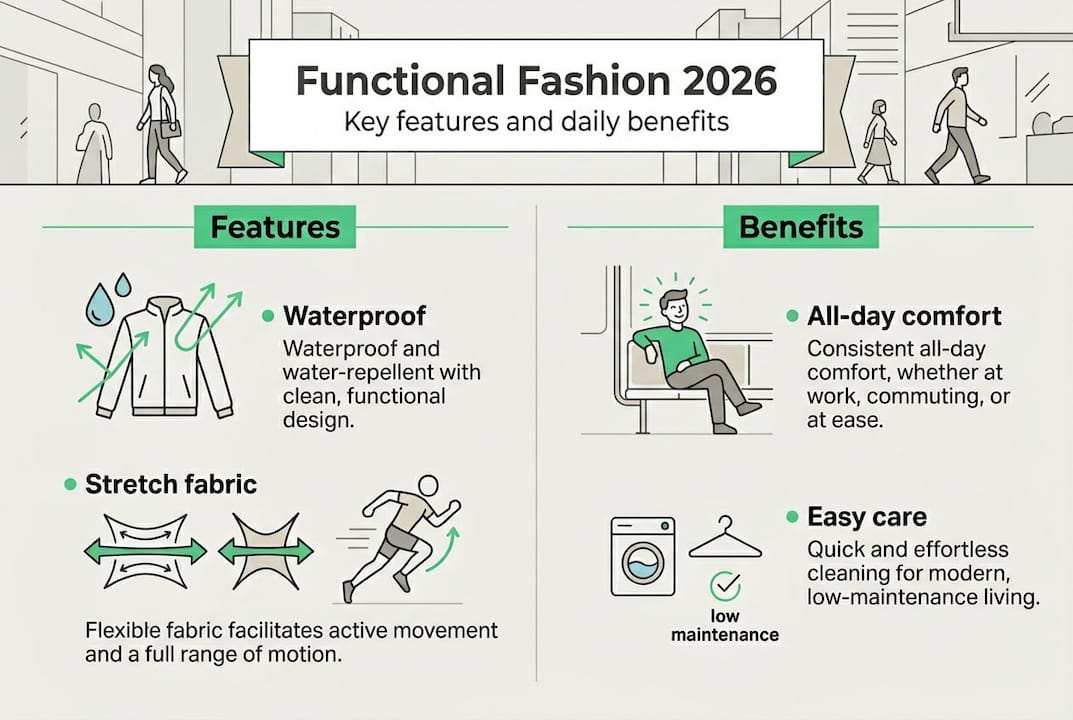
Functional fashion is clothing engineered to do more than look good. It combines innovative materials, smart construction, and purposeful design to deliver real utility. Think water resistance, odor control, stretch, breathability, and durability built directly into the fabric itself.
This is not just a niche trend. Functional fashion is redefining urban style by shifting the definition of luxury away from brand logos and toward measurable performance. For city professionals and active individuals, that shift is meaningful. Your clothing needs to survive a morning commute in the rain, a packed workday, and an evening run without missing a beat.
As one industry observer puts it, function is the new luxury, prioritizing performance and versatility over pure aesthetics. We see this reflected in the rise of techwear and the mainstreaming of high-performance fabrics across everyday clothing categories.
Here is what functional fashion addresses that traditional clothing often does not:
Urban resilience: Protection from weather, pollution, and physical wear
Sustainability: Fewer replacements, smarter materials, and a fresh take on sustainability built into the product lifecycle
Real-life usefulness: Clothing that adapts to multiple contexts without losing its shape or function
Low maintenance: Less washing, less ironing, less effort overall
“The most forward-thinking brands are no longer asking how a garment looks on a runway. They are asking how it performs on a Tuesday morning when everything goes sideways.”
The science behind innovative fabric technologies
Once we recognize functional fashion’s rising significance, it is time to look at the cutting-edge technologies fueling this transformation. The science is genuinely impressive, and understanding it helps you make smarter buying decisions.
GORE-TEX is one of the most recognized names in performance fabrics. Its ePTFE membrane contains pores that are 20,000 times smaller than water droplets yet 700 times larger than water vapor molecules. That precise engineering is what makes a jacket waterproof and breathable at the same time. It is not magic. It is physics applied to fabric. You can explore more about GORE-TEX technology details to understand how these membranes are constructed.
Beyond membranes, nanotechnology is reshaping what fabric can do. Nanotech coatings and smart textiles now offer antibacterial properties, water and oil resistance, and even sensor integration for health tracking. These are not futuristic concepts. They are available in garments you can buy today, including our knitted non-iron shirt in navy, which uses fabric technology to resist wrinkles and maintain freshness through long wear days.
Technology | Key feature | Real-world benefit |
GORE-TEX membrane | Waterproof and breathable | Dry comfort in rain and high activity |
Nanotech coating | Water, oil, and odor resistance | Low-maintenance, long-lasting freshness |
Smart textiles | Embedded sensors | Health and movement tracking |
Seawool fiber | Odor control and softness | All-day comfort without frequent washing |
FreshCore™ | Stain and odor resistance | Fewer washes, longer garment life |
The pace of innovation here is accelerating fast. Each of these technologies solves a specific problem that traditional fabrics simply cannot address.
Advanced manufacturing: Building for durability and comfort
With the science laid out, we turn to the manufacturing stage, where modern methods create tangible differences you can feel and trust. Great fabric technology means nothing if the construction process undermines it.
Modern functional garment manufacturing uses techniques like lamination, fibrillation, densification, and circular T2T recycling. Lamination bonds multiple fabric layers together, creating garments that are simultaneously weatherproof, flexible, and durable. Circular textile-to-textile recycling means end-of-life garments can become new ones, reducing waste at scale.
Researchers are also exploring MXene fibers in garments, a class of advanced conductive materials that could bring next-generation smart functionality to everyday clothing. The manufacturing pipeline is evolving quickly.
Feature | Traditional garment | Functional garment |
Construction | Single-layer woven or knit | Multi-layer laminated or bonded |
Durability | Moderate, degrades with washing | High, engineered for repeated use |
Maintenance | Frequent ironing and washing | Low-maintenance, quick-dry |
End of life | Landfill | Recyclable or biodegradable options |
Our knitted non-iron shirt in teal blue and knitted non-iron shirt in black are built on exactly this kind of thinking. Engineered construction, not just engineered fabric.
Pro Tip: Always check the care label before washing functional garments. Many high-performance fabrics require cold water, gentle cycles, and air drying to maintain their technical properties. Heat is the enemy of most coatings and membranes.
How functional fashion enhances urban and active lifestyles
This technical foundation creates garments that are not just impressive on paper but genuinely useful for day-to-day life. Let us connect the dots between the science and your actual schedule.
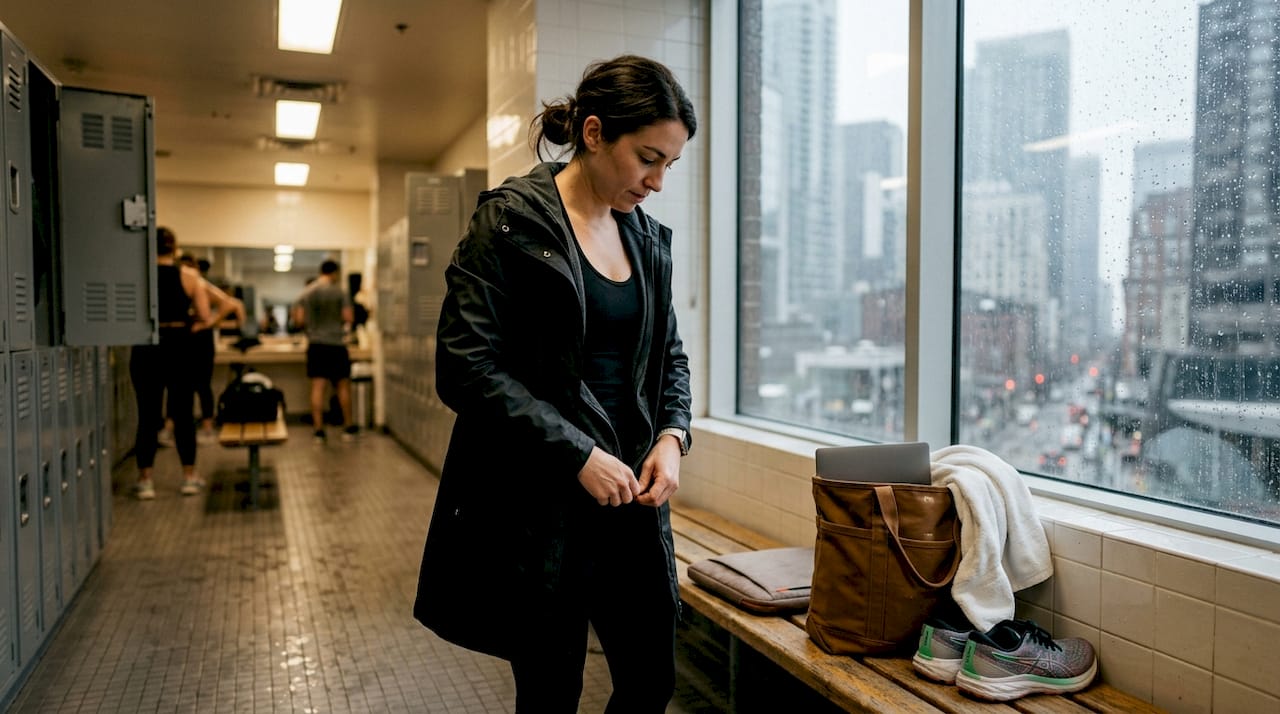
Imagine your Tuesday: a rainy commute, back-to-back meetings, a gym session at lunch, and a dinner out. Traditional clothing forces you to pack multiple outfits or accept discomfort. Functional clothing is designed to handle all of it. Stretch fabrics move with you. Breathable membranes regulate temperature. Odor-resistant treatments keep you fresh. Wrinkle-resistant construction means you look sharp from morning to evening.
The global functional apparel market neared $510 billion in 2025, a number that reflects genuine consumer demand, not hype. People are voting with their wallets for clothing that performs.
Here are the top benefits for city and active life:
Weather adaptability: Water resistance and breathability for unpredictable urban conditions
All-day comfort: Stretch and ergonomic construction for movement and long wear
Low-maintenance: Fewer washes, no ironing, and quick drying save time and energy
Versatility: One garment covers multiple contexts, from office to outdoors
Sustainability: Buying fewer, better pieces reduces your overall footprint
Our knitted non-iron shirt in blue is a practical example of this versatility in action. Pair it with our sustainability initiatives philosophy and you get clothing that is built to last and designed to minimize environmental impact.
“Functional fashion is not about wearing gear to the office. It is about wearing clothing that respects your time, your body, and the planet.”
Sustainability and inclusivity: Beyond utility
Modern functional fashion does not end with you. It shapes how we collectively reduce waste and make style more accessible to more people.
Sustainability in functional fashion comes from longevity, not just materials. Garment durability and better care practices across the full lifecycle matter more than fabric content alone. A shirt you wear 200 times has a dramatically lower environmental cost per wear than a trendy piece worn five times before it falls apart.
Here is how you can maximize sustainability through smart choices:
Wash less often. Functional fabrics resist odor and stains, so you genuinely do not need to wash after every wear.
Use gentle detergents. Harsh chemicals degrade technical coatings faster.
Air dry whenever possible. Heat damages membranes, coatings, and elastic fibers.
Buy intentionally. Choose versatile pieces that work across multiple contexts.
Repair before replacing. Many functional garments are designed to be repaired, extending their life further.
Inclusivity is another growing dimension of functional fashion. Adaptive design, which creates clothing accessible to people with disabilities or non-standard body types, is gaining momentum. However, adaptive fashion faces production standardization hurdles that the industry is still working to solve. Progress is real, but there is more work ahead.
One challenge worth naming honestly: PFAS (per- and polyfluoroalkyl substances) are still used in some DWR (durable water repellent) coatings and carry environmental concerns. The rise of functional fashion is pushing brands to find PFAS-free alternatives, and that transition is actively underway. Our own fresh take on sustainability reflects our commitment to making better choices as the technology evolves.
Pro Tip: Check whether a brand’s DWR coating is PFAS-free before purchasing. It is a small detail that makes a meaningful difference over time.
Limitations, misconceptions, and what to watch for
To get the best out of your functional wardrobe, it is crucial to understand what works, what does not, and why. No technology is perfect, and honest expectations lead to better outcomes.
Even GORE-TEX has limits. High humidity or worn-out DWR coatings can reduce a garment’s waterproofing performance over time. When the outer fabric becomes saturated, it reduces breathability even if the membrane itself is intact. Regular re-treatment with a DWR spray restores performance.
Smart textiles face a different challenge. Washability remains a significant hurdle for garments with embedded electronics or sensors. Most current smart garments require careful hand washing or specialized care to preserve their functionality.
Here are the most common myths and the realities behind them:
Myth: Waterproof means you will never feel wet. Reality: Sweat from inside can still create dampness if breathability is compromised.
Myth: Functional clothing never needs washing. Reality: It needs less washing, but not zero washing. Odor-resistant does not mean odor-proof forever.
Myth: All technical fabrics are sustainable. Reality: Some coatings and synthetic fibers carry environmental costs that brands are still working to reduce.
Myth: Smart textiles are ready for everyday use. Reality: They are improving fast, but durability through repeated washing is still a work in progress.
“The best functional garment is one you understand how to care for. Knowledge is the final layer of performance.”
Explore high-performance functional fashion options
Armed with this understanding, you are ready to build a smarter, more capable wardrobe. We have spent years developing clothing that puts these innovations to work for real people with real schedules.
Our functional shirts use FreshCore™ and Seawool technologies to deliver odor resistance, stain resistance, and low-maintenance wear that holds up through long days and frequent travel. Our performance pants are built for the same versatility, moving from desk to commute to weekend without skipping a beat. And when the weather turns, our water-repellent performance jacket brings genuine protection without sacrificing style. Every piece we make is designed to do more, last longer, and ask less of you. That is functional fashion in practice.
Frequently asked questions
What defines functional fashion in 2026?
Functional fashion uses advanced fabrics and designs to provide utility, comfort, durability, and often sustainability beyond conventional style. It integrates innovations like GORE-TEX, nanotech, and smart textiles into everyday wearable clothing.
Is more expensive clothing always more durable?
No. Studies show budget garments can outperform pricier items in durability tests. A £4 T-shirt outranked a £395 designer shirt for durability in independent lab testing.
How should I care for functional clothing?
Follow care labels closely, use neutral detergents, avoid high heat, and air dry when possible. Consumer care is critical to maximizing garment durability and preserving technical coatings.
What makes functional fashion sustainable?
Durable design, reduced washing frequency, and increasing use of recyclable or eco-friendly materials all contribute. Sustainability comes from longevity and fewer replacements, not just fabric content.
Can smart textiles survive regular washing?
Not always. Washability is a significant hurdle for garments with embedded electronics or sensors, and most require specialized care to maintain their performance over time.
Recommended
Comments